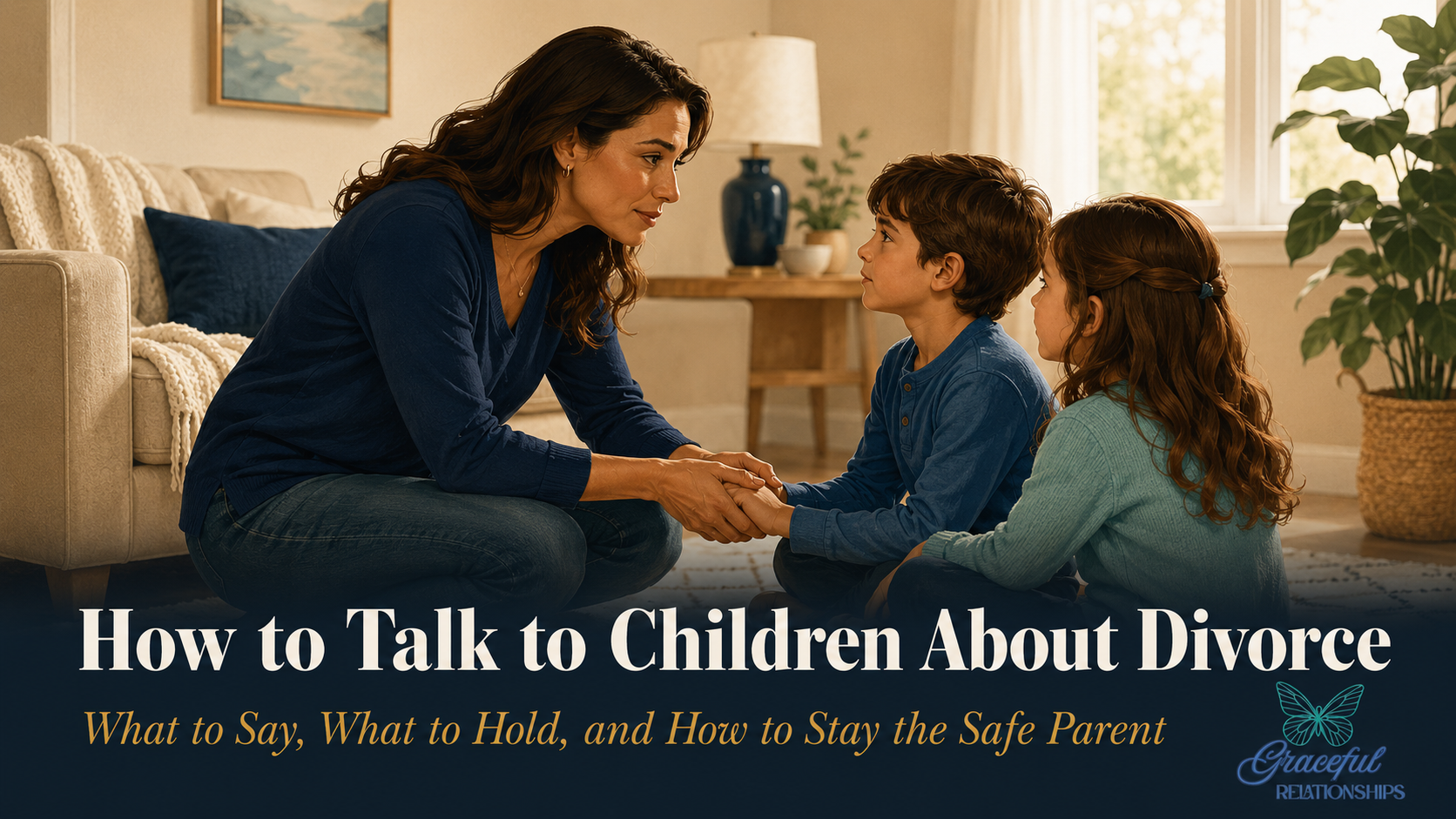
How to Talk to Children About Divorce: What to Say, What to Hold, and How to Stay the Safe Parent
She had rehearsed the words a dozen times. She knew she needed to learn how to talk to children about divorce before the moment came. Then it arrived and everything she had prepared dissolved, and she found herself saying too much, watching their faces change in ways she could not take back.
Most mothers describe this as one of the hardest moments of the entire process. Not the filing. Not the legal appointments. Not even the hardest conversations with the other parent. The moment they had to look at their children and say: something is changing.
Knowing how to talk to children about divorce is one of the most consequential things a mother can do during a high-conflict separation. There is no perfect script. There are, however, practices that help children feel safer, and choices that make the difference between a child who is protected from adult conflict and a child who is inadvertently pulled into it.
The Ideal: Two Parents, One Conversation
When it is safe and possible, many child-development and pediatric professionals recommend that both parents deliver the news together, using calm and simple language. Not because everything is fine between them. Not because they agree on the details. Because children need to see that their parents, even in the middle of significant disagreement, can set that aside and show up together for them.
That conversation sounds like this: Mom and Dad have decided that our family is going to look different now. We are going to live in two homes. You will have your home with Mom and your home with Dad. This is an adult decision and it is not because of anything you did. We both love you and we will both keep taking care of you.
Several things in that language are intentional. The child has two homes of their own, not two parents’ houses they visit. The decision belongs to the adults. The love is stated as fact, not as comfort. There is no room in the message for blame, comparison, or invitation to take sides. Understanding how to talk to children about divorce begins with this foundation: the message belongs to both parents, delivered together whenever it is safe to do so.
When the Ideal Is Not Possible
Reality often falls short of the ideal. A co-parent may refuse to participate. They may be absent, unreachable, or make the setting unsafe. In those cases, a mother does the best she can with what she has.
This is where coaching enters the picture. The goal is to work with the parent who is showing up. The one who is asking how to do this well. The one who wants to protect her children even when the other side of the equation is not cooperating.
If you are doing this conversation alone, you still lead with unity wherever you can. You still say: we both love you. You still keep the focus on the child’s reality, not the adult conflict. You give them what they need to feel safe, even when the situation around them is not.
What Children Need to Hear When You Talk to Them About Divorce
When thinking about how to talk to children about divorce, the goal is not a perfect explanation. It is a safe one. Children do not need to understand why the divorce is happening. They need to understand what it means for them. Underneath every reaction, regardless of age or how the question is phrased, are the same four questions. Where will I live? Will I still see both parents? Will my life change? Will I be okay?
Your job is to answer those questions directly, simply, and repeatedly. Children process this news in stages and often return to the same questions days or weeks later. That is not a sign the first conversation failed. It is a sign they are working through something significant.
Keep coming back to the same steady answers. Keep the language concrete. In our home, bedtime stays the same. You will still go to your school. Adults are handling the adult parts. That repetition is not redundancy. It is reassurance.
What Child-Focused Language Looks Like When Talking to Children About Divorce
The difference between language that protects and language that burdens is often subtle.
Instead of: “Dad decided he didn’t want us to live together anymore.”
Say: “Mom and Dad have decided our family is going to look different. You will have your home with Mom and your home with Dad.”
Instead of: “I’m going through a really hard time right now.”
Say: “This is a big change. It is okay to have big feelings about it. I am here.”
Instead of: “You can always tell me everything.”
Say: “If you have questions, you can ask me. You never have to worry about hurting my feelings by asking.”
The first set places adult weight on a child. The second keeps the weight exactly where it belongs.
Why Keeping Adult Conflict Out of the Conversation Matters
The Centers for Disease Control and Prevention identifies exposure to instability and conflict from parental separation as an adverse childhood experience, an ACE. Research consistently shows that repeated, intense, or unresolved conflict increases children’s risk of lasting effects on brain development, emotional regulation, and the capacity to form healthy relationships later in life.
That is not an argument for pretending conflict does not exist. It is an argument for keeping it out of your children’s hearing, out of your conversations with them, and out of the space they need to simply be children.
In high-conflict situations specifically, courts and professionals are trained to identify when a parent’s behavior draws children into adult conflict. The parent who keeps children consistently protected from that conflict, over time, is demonstrating the child-focused judgment that matters most when professionals are evaluating the situation.
Signs Your Child May Be Struggling
Children show distress in ways that shift with age. Recognizing those signs early allows you to respond before distress becomes entrenched.
Younger children may regress in behaviors they had already mastered, become clingier than usual, have sleep problems or nightmares, cry more, or show separation anxiety. These responses are not signs something is wrong with the child. They are signs the child needs more steadiness right now.
School-age children may blame themselves, worry about being abandoned, become irritable or socially withdrawn, or begin struggling academically. They may have physical complaints like stomachaches that appear without an obvious cause. A noticeable change in school functioning is always worth paying attention to.
Teenagers may become angry, emotionally shut down, or pull away from family entirely. They may seem indifferent while needing reassurance and structure more than ever. Even teenagers who act like they do not need you benefit from predictable routines and low-conflict communication at home.
If a child is showing significant or persistent distress, additional professional support may be warranted. Coaching helps a mother prepare, regulate, and show up more clearly, but children with significant distress often benefit from a therapist who specializes in child development or family transition as well.
What Consistency Looks Like in Your Home
Your children do not need identical homes. They need at least one predictable home.
In your home, that means keeping the basics steady: bedtime, wake time, meals, homework expectations, screen time, and transitions. Predictability tells a child they are safe. When the larger structure of the family is shifting, what stays the same becomes the anchor.
Keep school attendance consistent. Keep extracurricular activities and friendships in place where possible. Keep religious practices and family traditions that ground your children.
And protect your home from what does not belong in it: adult arguments within the child’s hearing, negative comments about the other parent, and asking children to carry messages between homes or report on what happens there. Your home is their haven. That is yours to protect, regardless of what is happening elsewhere.
When the Other Parent Will Not Cooperate
This is the reality most coaching conversations live in. One parent is showing up. One parent is not.
The answer is not to lower your own standard to match theirs. The answer is to become the most consistent, child-focused parent your children have access to, and let that consistency speak for itself.
In practical terms that looks like this. You cannot control what happens in the other home. You can keep your own home steady. You do not argue through your children. You do not ask them to report on the other parent’s choices. When face-to-face conversations escalate, written communication keeps the focus on logistics and the children’s needs.
Children do better when at least one home remains emotionally steady, predictable, and free of conflict escalation. You are building that home. That matters. It is seen, even when it feels like no one is watching.
Where You Put What You Cannot Put in the Conversation
The feelings do not disappear just because they cannot go into the child conversation. They need somewhere to go.
Coaching provides that space. A place to put down everything you are carrying so that you can walk into the room with your children steadier, clearer, and genuinely present for them. The mother who has processed the hardest parts of her week before she sits down with her children walks into that room differently than the woman who has been carrying all of it alone.
Coaching is not just strategy. It is what makes the strategy possible.
If you are in this moment and not sure how to find that steadiness, the free divorce assessment at Graceful Relationships gives you a personalized picture of where you are and what kind of support fits your stage. It takes four minutes.
Take the free divorce assessment here.
For additional educational resources on child-focused support and high-conflict divorce, visit the free resources page.
A complimentary 45-minute consultation is available when you are ready to talk through your specific situation. No pressure. No obligation. Just clarity.
Book your complimentary consultation at gracefulrelationships.com.
Mary Ballard, Founder and Coach of Graceful Relationships, is a CDC Certified Divorce Coach specializing in high-conflict divorce, parental alienation, and attachment-based recovery. She works with high-capacity women nationwide via Zoom.
This content is for educational purposes only and is not a substitute for legal, psychological, or medical advice.