Transition and recovery. Skip one, and the other quietly costs you for years.
If you don’t learn how to move from a marital relationship into a working co-parenting relationship, it rarely stays contained between the two of you. It shows up as conflict your kids end up carrying for the next ten to fifteen years, sometimes longer, and underneath that, most parents carry a quiet guilt about it too. Working through this well means your kids get to grow up without carrying a war that was never theirs.
Recovery works the same way. Skip it, and the pattern doesn’t disappear, it just waits, showing up in your next relationship or in how you react under stress with your own kids. Do the work now, and you get to walk into whatever comes next as someone who actually broke the pattern, not someone still carrying it.
This matters even if your children are already grown. If you are exiting a long-term marriage or navigating a gray divorce, and gray divorce has become increasingly common among long-married couples, you still built an entire social architecture together over decades: friend groups, family traditions, a shared place at every milestone. That does not have to disappear along with the marriage. The alternative is missing your own child’s wedding, or a grandchild’s milestones, simply because the two of you never learned how to be in the same room.
Transition
- Skip this: the conflict becomes something your children carry for years, and something you carry as guilt long after the divorce is final.
- Work through it well: your kids grow up getting the best of both of their parents, learning what healthy relationships look like.
Transition is the structural work of moving from one life to another. Specifically, it includes:
- Restructuring from the marital relationship to the co-parenting relationship
- Separating finances, assets, and shared responsibilities
- Preparing for attorney meetings so retainer cost is protected
- Separating the emotions from the business of divorce to make strategic decisions instead of emotional ones
- Building a clear plan when the path forward still feels uncertain
Recovery
- Skip this: the pattern waits for your next relationship, or the next moment your kids need you steady.
- Do this work: you get to show up as someone who actually grew and changed, not just someone who moved on.
Recovery is the deeper work that runs alongside the transition. Moreover, many people skip it entirely, which is why old patterns tend to surface again later. Recovery includes:
- Rediscovering who you are outside of the marriage
- Processing grief without letting it drive your decisions
- Rebuilding your identity, confidence, and sense of purpose
- Understanding the patterns that shaped your last relationship
- Designing the next chapter of your life on your own terms
My role is to walk with you through both. Instead of telling you what to do, I help you hear yourself clearly enough to decide for yourself, with strategy and intention rather than fear or survival instinct.
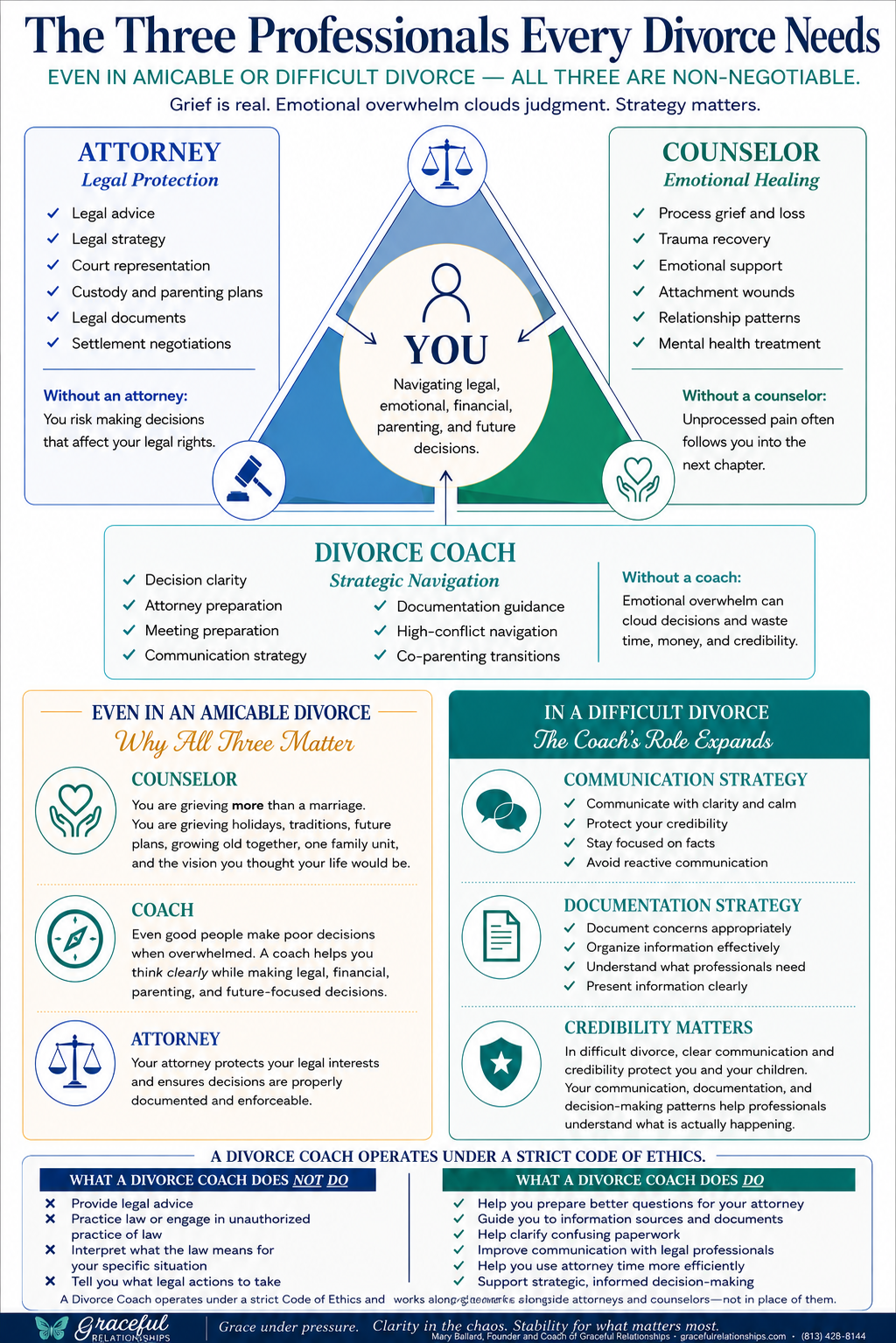
The complete team your divorce needs. Each role matters. Each role is different.
Most people hire an attorney and perhaps a therapist, and assume those two roles cover everything. However, there is a significant gap between legal advice and emotional healing. A divorce coach fills that gap. Furthermore, when all three professionals work in their correct lanes, you make better decisions, protect your credibility, and move through the process more efficiently.
At a glance, here is how each role works
The full breakdown of each role, including what happens when any one of them is missing, is shown in the graphic below.
Six areas of depth, each one built from lived experience.
Divorce coaching is broad. Transition and recovery coaching is specific. These six areas were not chosen from a course catalog. They were earned.
I hold specialty certifications in Transition and Recovery and in High-Conflict Divorce, and I have also lived a high-conflict divorce myself, so I understand it from the inside, not only from a textbook. Twenty-five years in education include nine years spent simultaneously as a homeschool evaluator, homeschool teacher, and homeschool mom, walking the full arc from kindergarten through high school. That is exactly why protecting a child’s homeschool stability through divorce matters so much to me.
My own divorce is part of this too. As a Christian who believes deeply in marriage, filing the first time left me carrying real shame, the sense that I had somehow failed, and an isolation that few people around me understood. My husband and I reconciled after that. When I filed a second time, I had grown enough in my faith to let it become a strength instead of a source of shame, and that shift changed everything about how I moved through the process.
Most divorce coaches are not also relationship coaches. I became one while navigating my own divorce, learning to recognize my own old triggers and remove them, one at a time. That work let me stop believing I wasn’t worthy, and start knowing I could handle whatever came next. It also made child-focused, solution-oriented communication possible for me, instead of reacting from fear or hurt.
That same work is exactly what reshapes how someone dates after divorce. Clients often ask me, while reflecting on their marriage, how could I have ever chosen someone who ___? Everyone’s blank is different, but the answer is almost always the same: shadow work. Understanding it is what moves you out of a loop you cannot explain and into a position of real empowerment, where you get to change the pattern instead of staying stuck in it. From there, healthy boundaries and knowing how to recognize and receive what you actually need become possible, and dating finally stops repeating the past.
Transition & Recovery
- Skip this: you’re left with no idea how to rebuild, floundering and out of control.
- Work through it: you rebuild with an actual plan, designing the life you were called to instead of pure survival instinct.
- Restructuring from the marital relationship to the co-parenting relationship
- Separating the emotions from the business of divorce
- Building your strategy before you are deep in crisis
- Preparing for attorney meetings so retainer cost is protected
Homeschool Stability Through Divorce
- Skip this: your homeschool journey may end sooner than you wanted, one more part of your children’s life that changed before anyone was ready.
- Protect it: your kids keep a major piece of their life while everything else shifts around them.
- Protecting educational continuity during the transition
- Planning for dual-home curriculum and scheduling
- Navigating the legal requirements of homeschooling during divorce
- Supporting the parent who carries the educational relationship
Emotional Intelligence & Attachment Theory
- Skip this: the same triggers and reactions follow you into whatever comes next.
- Do this work: you respond from clarity instead of reactivity, finally breaking the pattern instead of repeating it. Unhooking those triggers lets you show up differently in every area of your life, more confident and secure.
- Understanding why conflict escalates and how to interrupt it
- Recognizing your relational patterns under stress
- Making decisions from clarity rather than fear or reactivity
- Building the foundation for healthier relationships going forward
Faith-Based Coaching (Optional)
- Skip this: fear or shame can quietly push you away from your faith right when you need it most.
- Lean into it here: it becomes a source of strength instead of something you have to hide from.
- Applying biblical principles to decisions and next steps
- Working through the tension between faith and divorce honestly
- Leaning into your faith as a source of strength rather than shame
- Always optional, never required, and offered only if you want it
Dating After Divorce
- Skip this: the same patterns end up back in the room with someone new.
- Do this work: you date intentionally instead of on autopilot.
- Knowing when you are emotionally ready to date again
- Recognizing and breaking the patterns that did not serve you
- Dating intentionally when your children are part of the equation
- Avoiding the rebound relationship that costs everyone later
High Conflict Divorce
- Skip this: it’s genuinely isolating, no one around you understands what high-conflict is actually like, and well-meaning advice from people who don’t get it can quietly hurt your case.
- Work through it with someone who does: you stay grounded, credible, and strategic when the process turns contentious.
- Communicating in ways that protect your credibility with the court
- Documentation strategy for what attorneys and evaluators need
- Understanding high-conflict personalities and how to respond
- Protecting your children’s wellbeing throughout the process
If any of this sounds like the support you have been missing, the next step is a simple conversation.
Smart people make predictable errors when this much is on the line.
Divorce forces enormous decisions at the exact moment your capacity to make them is most compromised. There are four pitfalls I watch for in every client, and I help you avoid every one.
- You consider too few options, because black-and-white thinking has trapped you in partner versus partner, this or that, when better paths usually exist between the extremes.
- You fall into confirmation bias, where your stressed nervous system narrows your vision so that you only notice the evidence that supports what you already believe.
- You let short-term emotion drive decisions that deserve long-term thinking, trading a future gain for the relief of feeling right today.
- You become either over-confident or under-confident about how the future will unfold, when the honest truth is that this season offers very few certainties at all.
Together, we widen your options, check your own thinking, and separate the momentary emotion from the lasting consequence. As a result, you make grounded decisions in a situation that offers no guarantees.
Your journey to clarity, strength, and a life you choose.
Every client enters this work at a different point on the map. Some arrive at Stage 1, still asking whether to stay or go. Others arrive mid-process at Stage 3 or 4, trying to understand what they are navigating and how to prepare wisely. Still others arrive after the legal process is complete, at Stage 6, finally ready to begin healing and recovery. Wherever you are, there is a next right step.

Choose the level of support that fits where you are right now.
Every path begins with a complimentary consultation, where we map what is ahead and decide together whether we are a good fit for transition and recovery coaching. Not ready for a full consultation yet? Start with a free divorce resource instead.
The Monthly Coaching Membership
Week-to-week support for the long haul, ideal when you are near the beginning of your divorce and want strategic help all the way through. Weekly one-on-one sessions run 55 minutes, and membership also includes priority scheduling access, ten minutes of additional coaching support once a week, and a quarterly 30-minute Clarity Check-In. $575 a month, cancel anytime
Single Sessions
Not ready for ongoing support, or simply need help thinking through one specific decision right now? A single 55-minute one-on-one session is here whenever you need it, with no commitment and no package to track. $175 per session